

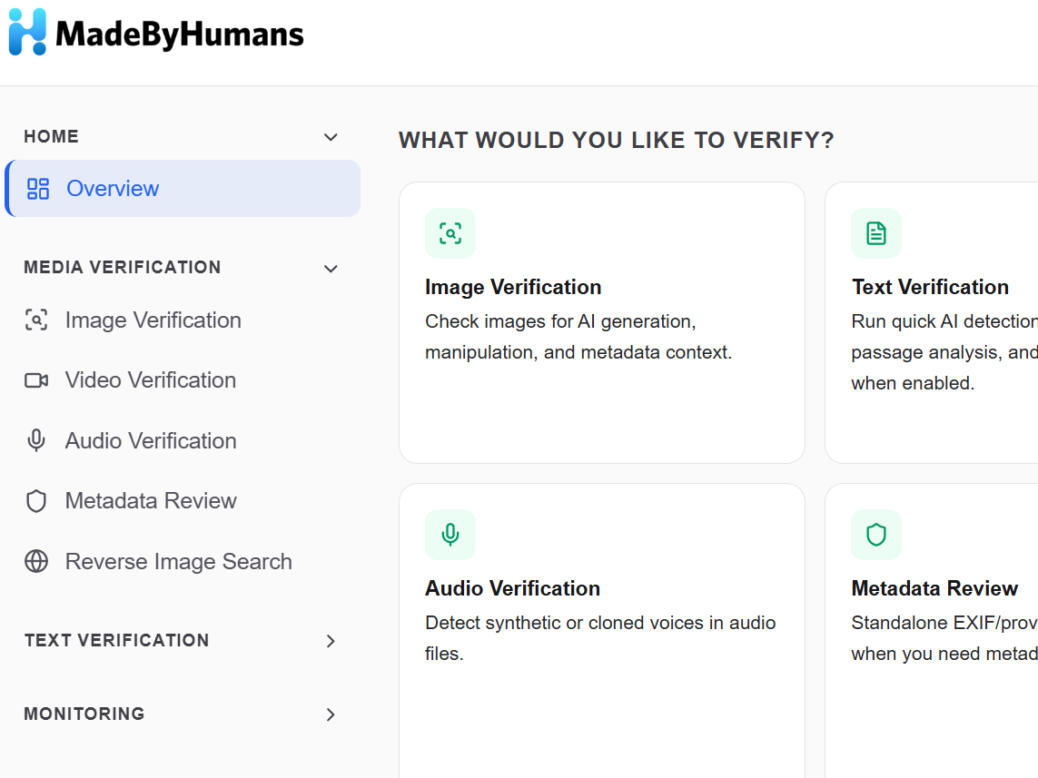
Press Gazette today launches a new tool for publishers that aims to protect them from publishing misleading AI-generated content.
It follows this publication’s Reality Wars investigations into the rise of fake experts, infecting the news ecosystem with AI-generated commentary.
Press Gazette also exposed fake freelance Margaux Blanchard who used AI to pitch invented news features which made it into publication. And newspapers around the world were duped by an AI-manipulated image posted by a Thai police force, which falsely claimed hardened detectives dressed as showgirls for an undercover drugs bust.
Editors can now check whether content is AI-generated or manipulated before publishing by using a specialist tool designed for newsrooms.
Press Gazette has partnered with Flip-Pay, the enterprise solutions provider for publishers, to build Made by Humans, a platform designed to help media owners manage the editorial, legal and reputational risks associated with publishing AI-generated content.
A Press Gazette survey of more than 200 publishers, editors and journalists found 95% of respondents believe AI-generated content should be flagged to readers, yet 64% said their publication has no way of reliably checking for unauthorised AI use.
Some 87% felt making some sort of “human-made” guarantee around content would increase trust among website readers.
Made by Humans incorporates industry-leading AI-detection technologies, including Pangram and Identifai, into one dashboard that checks text, images, video and audio for AI manipulation before publication.
It can be incorporated directly into content management systems, meaning editors automatically see a warning when they are about to publish content that shows signs of AI manipulation.
Press Gazette has become the first publication to trial Made by Humans inside its own CMS.
Editor-in-chief Dominic Ponsford said: “We named our investigations into AI-generated content ‘Reality Wars’ because quality, human-authored journalism is in a fight for survival against misleading AI-written bilge.
“We’ve seen hundreds of stories taken down by reputable titles after elements have been identified as misleading or AI-generated. This tool will help to stop such articles before publication.
“Made By Humans helps protect publishers from the colossal reputational damage that could come from publishing misleading AI-generated material, and is a tool to support, not replace, human editorial judgment.
“Like many publishers, we use AI for things like transcriptions, research and data analysis. But we pride ourselves on ensuring that human creativity, originality and curiosity underpin our journalism. This technology helps verify that all our content is ‘human-made’.”
Made by Humans can review content in four languages – English, French, Spanish and German – at both article and sentence-level, with language-specific interfaces. It also allows editors to check whether content is original, has been plagiarised or has appeared elsewhere.
It plugs into WordPress and other content management systems for automatic pre-publishing verification and records each review and interaction to support compliance and auditing.
Publications can also generate reports and earn a trust badge to display on their websites signalling responsible use of AI to readers and advertisers.
Made by Humans was built and engineered by Flip-Pay, the Dublin-based technology company which builds enterprise subscription solutions for publishers, working on a concept developed by Ponsford.
Flip-Pay CEO Paul McCarthy-Brain said: “We work closely with publishers around the world and can see how AI is undermining their commercial authority and now, the quality and reputation of their editorial content, too.
“Made by Humans uses best-of-breed AI-detection technology and covers every content risk through one platform, which can be embedded right into the workflow.
“It offers editors a clear evidence-based assessment with an audit trail which can be useful for supporting EU compliance. It’s a shining example of how AI can be used to benefit publishers.”
Deepfake detection specialist Identifai reviews images, video and audio for Made by Humans. In Identifai’s own benchmarking, its lead image model detects AI-generated images with 99.8% accuracy, while its audio model, built to catch cloned and synthetic voices, reaches 91.8%. Its research is published in peer-reviewed IEEE and ACM journals and it has helped Press Gazette unveil fake experts during its Reality Wars investigations.
Identifai has logged around 10,000 deepfake incidents reported in English-language media or on social platforms since January 2020, and it says the frequency is rising sharply – from four reported incidents in January 2020 to more than 3,000 in March 2026.
Identifai vice president for EMEA Kate Burns said: “Almost anyone can now create a deepfake, and the most dangerous ones look exactly like the real thing. Many are picked up by hard-working fact-checkers and picture desks before they make it into the public domain, but editorial teams are on the front line here.
“Made by Humans supported by Identifai gives media and broadcasters the vital tools they need to ask the simple question ‘is this real?’ and greater peace of mind to publish.”
Pangram analyses text for Made by Humans and can identify content generated by major AI labs including OpenAI, Anthropic, Google, Meta and DeepSeek. Its latest model, Pangram 4, records increased accuracy detecting the latest AI models, and claims to generate just one in 10,000 false positives.
Pangram CEO Max Spero said: “AI-generated content is proliferating rapidly across many industries, and publishing is no different. We’re proud that Pangram is integrated with Made by Humans to increase transparency for media organisations.
“Pangram 4 is our most sophisticated and accurate detection technology yet. It offers sentence-level AI-detection for editors and is even more accurate. It also has built-in recognition against adversarial efforts like humanisers.
“Importantly for editors, Pangram 4 also distinguishes between AI-polished human writing and full AI generation, so it allows for journalists who might be using AI for tasks such as transcripts, research or light editing.”
Email pged@pressgazette.co.uk to point out mistakes, provide story tips or send in a letter for publication on our "Letters Page" blog
